Plant of the Month April 2026: Common Blue Violet
Common Blue Violet, Viola sororia/communis
April 2026 Plant of the Month
Northern Neck Chapter of the VNPS
Go Native Grow Native
By Betsy Washington
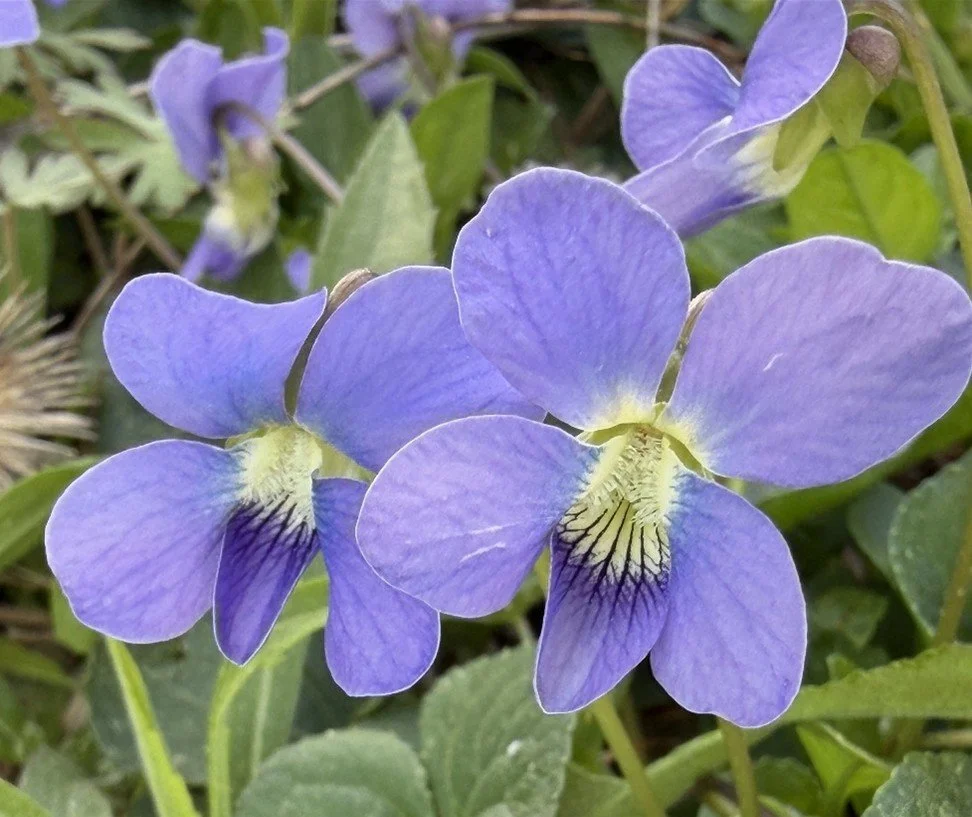
Lovely flowers of Common Blue Violet with intricately veined lower petal (by B. Washington)
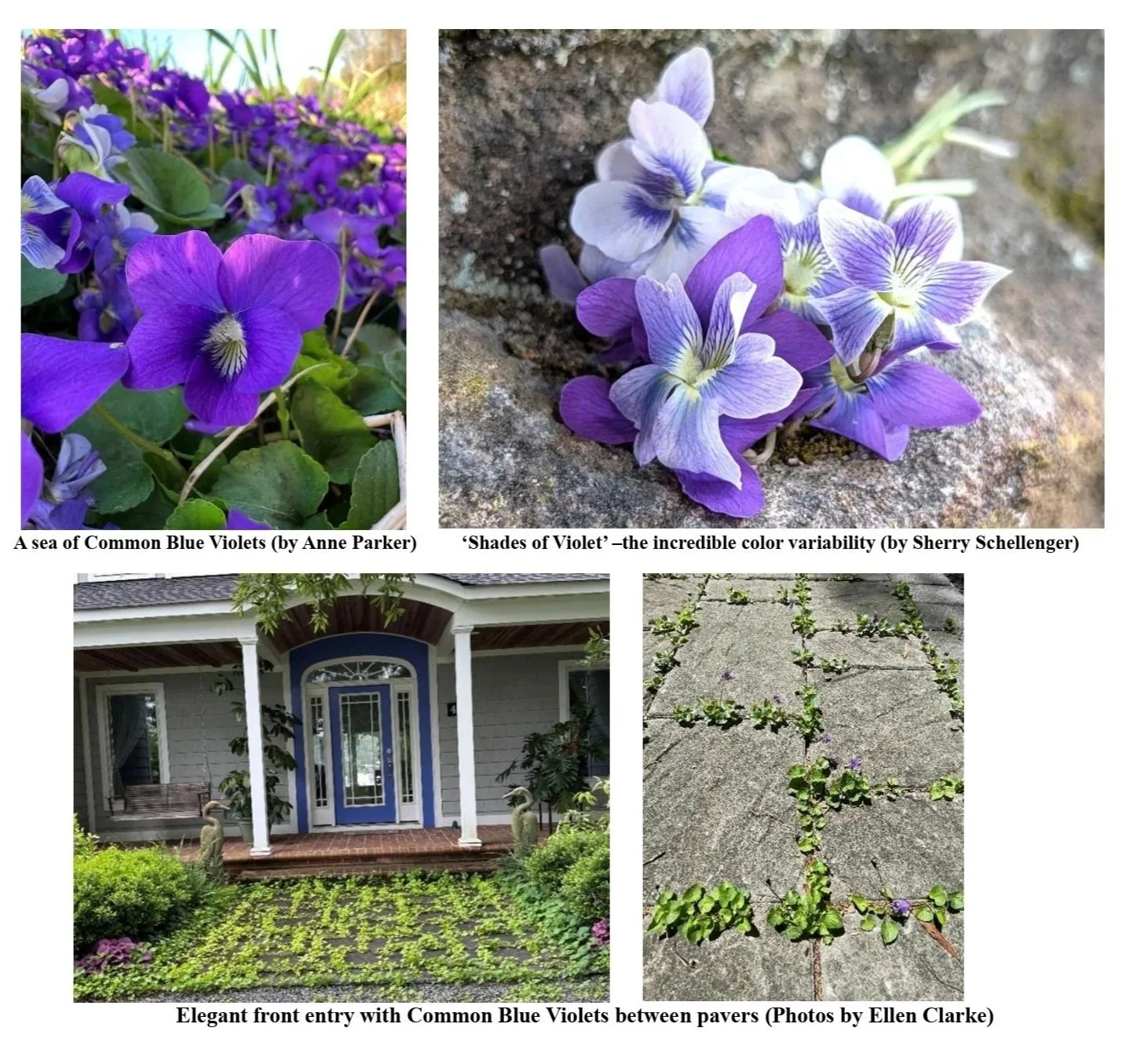
The cheerful flowers of our native Common Blue Violet are one of the most anticipated signs of spring, bringing joy to both gardeners and pollinators alike. Blooming from March to June, with occasional rebloom in fall, our Common Blue Violet reaches only 3 – 8” tall with showy violet-blue flowers with white throats and intricate purple veining. A popular variant with white flowers and violet veins and markings is known as the Confederate Violet and is sometimes found amongst the typical violet form, especially in disturbed sites, for reasons not understood. Each slightly nodding flower is held on a slender leafless downy stalk rising directly from the rhizome (horizontal underground stems), with a basal rosette of wide, heart-shaped leaves with rounded teeth borne on separate stems. Each flower has 5 petals with the lower petal conspicuously veined and extending backwards into a nectar spur. When pollinated, the flowers mature into three chambered seed capsules that will forcefully eject seeds when ripe. The short, branched rhizomes allow the violets to spread into small colonies where they often form a brilliant carpet of spring blooms. Violets have long been cherished for their beauty and as a nostalgic symbol of love, honesty and faithfulness and further treasured for both their medicinal and edible qualities. All violets, including the Common Blue Violet, also have small greenish-white flowers at the base of the plant that never open but instead are self-pollinated (termed cleistogamous). These often produce copious amounts of seeds.
The Common Blue Violet is known by many different names indicating its popularity, such as Dooryard Violet, Confederate Violet, Wooly Blue Violet, Wood Violet, Hooded Violet, Wild Violet and more! The genus Viola is a large and complex group with over 30 species in Virginia. One botanist, Harvey Ballard, who has spent his life studying Viola, believes there could be over 115 species in North America, many of which are in the Southeast but not yet described. To say the group is complex is an understatement! Although the Common Blue Violet is commonly found in most Virginia counties, the exact taxonomy and distribution is confused. It apparently hybridizes with several other species including V. communis, the Hooded Blue or Confederate Violet, and septentrionalis, Northern Blue or Woodland Blue Violet. The exact distribution of each of these species requires further study across Virginia but regardless of the exact taxonomic name, Common Blue Violets are wonderful native groundcovers and occur naturally in an extremely wide range of habitats from floodplain forests to stream and riverbanks, to moist upland forests and even clearings, fields and lawns. Obviously, Common Blue Violets are tough and adaptable and can thrive as a groundcover in a variety of challenging sites. They are deer resistant, can thrive in full sun in moist soils, and poorly drained, clay soils, and even under the shade of the allelopathic black walnut that deters many plants. They do prefer moist, humus rich soils in dappled shade where they spread readily; early farmers historically used Common Blue violets as an indicator of high fertility soils.
And planting Violets is good for the planet. They are considered an ecological ‘keystone’ species for pollinators and support the specialist miner bee, Andrena violae, whose larvae depend on the pollen of Violets. In addition, violets are an important early nectar source for a number of native bees, butterflies, moths and other pollinators, as well as being a critical host plant for caterpillars for many species of our large and showy Fritillary butterflies, such as Variegated and Great Spangled that are declining in numbers. Songbirds and small mammals eat the seed. Both flowers and leaves of Common Violets are edible for humans too – the flowers have been used in candies, jellies, and as garnishes while the young leaves which are rich in vitamin A and C are great when eaten fresh in salads or cooked like spinach.
Landscape uses for this lovely wildflower are varied as its adaptability. Common Blue Violet spreads by seed and by rhizomes and it makes an outstanding groundcover when allowed to naturalize and spread along woodland edges, in open woodlands, along pathways, under shrubs and of course in pollinator gardens. Ecologist Doug Tallamy, author of Bringing Nature Home and Homegrown Park recommends using them as a lovely groundcover for a butterfly garden. This vigorous species can spread into lawns adding color and nectar in spring (which I adore) but they can be considered weedy by those seeking a perfect lawn, which incidentally supports no pollinators. But simple regular mowing can help control them. Foliage can sometimes deteriorate during the hottest parts of our summers.
Common Blue Violet were one of the very first plants I added to my current garden, tucked in as a groundcover beneath native shrubs like Spicebush, Viburnums and Sweet Pepperbush and along garden paths to offer beauty a carpet of lovely spring blooms and to fill my gardens with butterflies, native bees and other pollinators. I urge you to do the same and enjoy the many benefits of this lovely and sometimes overlooked wildflower! We will have Violets for sale at our Annual Fall Plant sale next September.