Plant of the Month November 2026: Mockernut Hickory
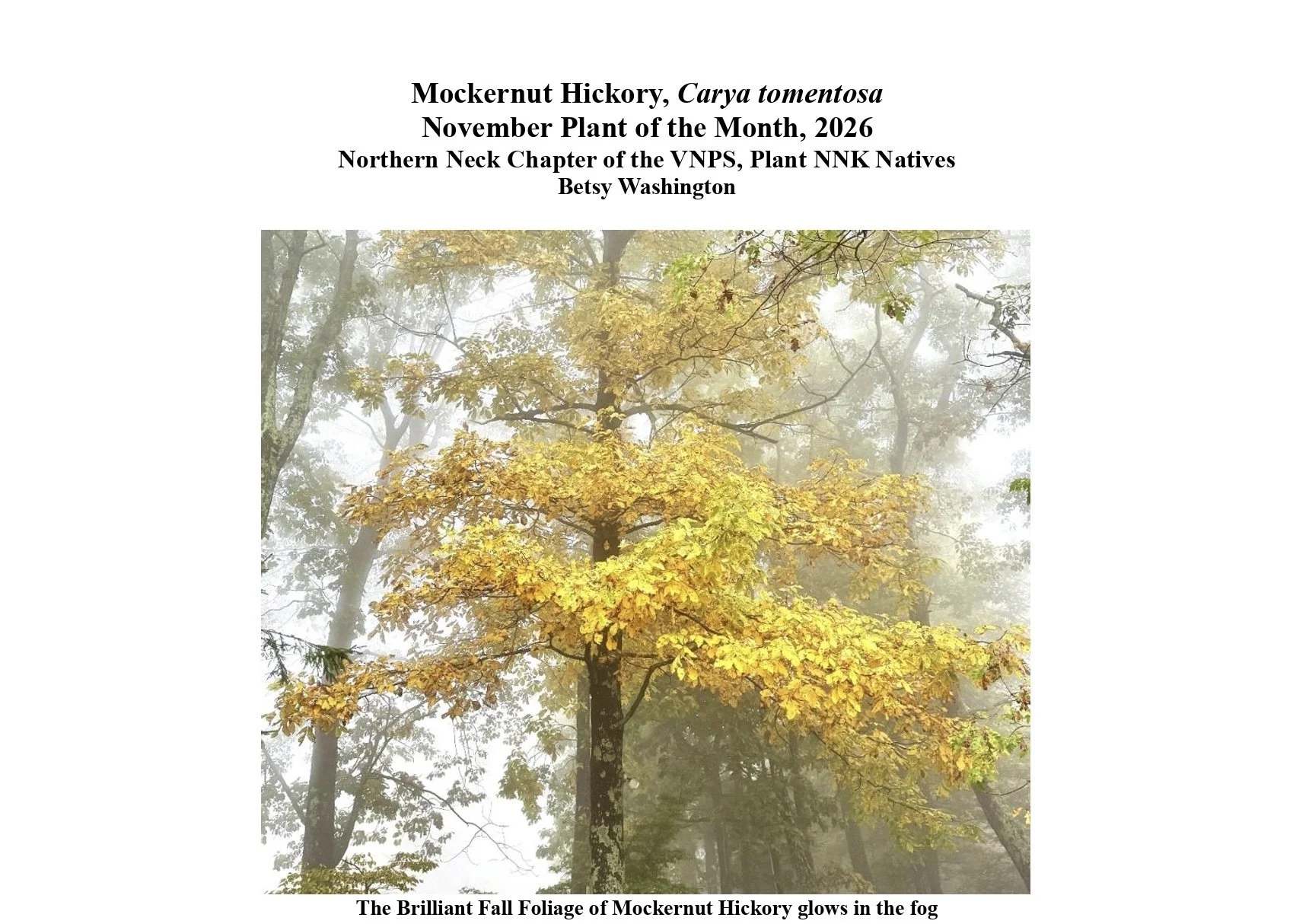
As I write this at the very end of October, the upland woods are glowing with the brilliant gold of our native hickories making this the perfect choice for our November POM. The noted horticulturist, Michael Dirr, wrote in his Manual of Woody Landscape Plants, “arguably, hickories offer the most beautiful yellow to gold fall color of any tree”. They are indeed gorgeous in their fall finery, but these tall, stately trees are beautiful in every season. They are long-lived with strong, straight trunks, dense, cylindrical crowns with sinuous branches, pinnately compound or divided leaves and are common throughout Virginia. Like many of our large, forest trees, hickories are monoecious meaning they have separate male and female flowers on the same tree that are wind pollinated. The male flowers are held in drooping yellow-green catkins up to 3 – 5” long while the small female flowers are held on short spikes. They produce edible hard nuts in thick shells that support an amazing array of wildlife including squirrels, chipmunks, deer, foxes, wood ducks, black bear and hogs. In fact, a mature hickory can produce up to 500 pounds of nuts in a good year! Hickories are a keystone species meaning that they support an amazing number of species of wildlife providing huge ecological benefits. They are reported to support 240 species of butterflies and moths including several species of Hairstreaks, the beautiful Luna Moth, and the Hickory Horned Devil, our largest caterpillar at 5-1/2” with large yellow eye spots that metamorphoses into the giant Regal Walnut Moth. The caterpillars of these lepidoptera in turn, support hundreds of species of birds and other wildlife. Hickories have incredibly hard wood that is “stronger pound for pound, than steel” (according to Native Trees for North American Landscapes by Guy Sternberg with Jim Wilson), making them incredibly resistant to snow, ice, and windstorms. Their wood has long been valued for its tensile strength and used in ax and tool handles, furniture, etc. and for its ability to burn ‘hotter’ than most other trees, making it highly valued for fuel, smoking, and charcoal. All Hickories provide huge yet underappreciated ecological benefits to our forest ecosystems. Preserve them if you are fortunate enough to have them growing on your property.
The Mockernut or White Hickory, Carya tomentosa, is one of the most common and beautiful Hickory species, ranging across much of the Eastern U.S. and southern Canada, and it is especially abundant in the southern part of its range and along the Atlantic Coast where it is commonly associated with Oaks and Pines in dry sandy forests. In fact, this species was the first described by John Tradescant the Younger in 1640 from his early botanical collections near the York River in Virginia. This beautiful tree is often described as growing 60 – 80’ in height with a tall straight trunk, but many grow to 100’ or more in height; the largest specimen was over 150’. On average they can live for 300 or more years with the oldest specimens documented, an astonishing 500 years in age.
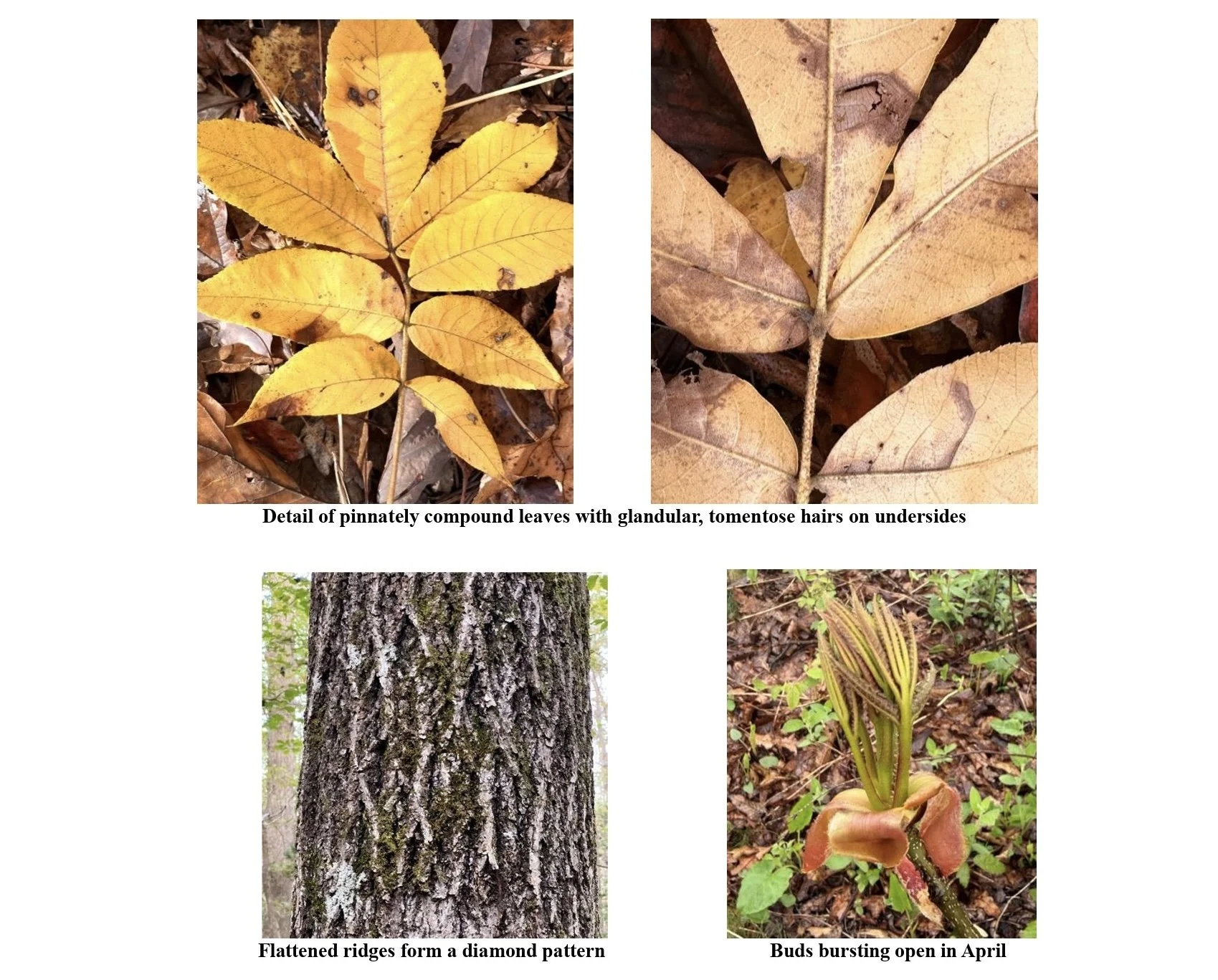
This species can be distinguished by its large, pinnately compound leaves (larger than most hickories at 8 – 15” long, usually with seven leaflets with serrate edges, that are covered with glandular, fuzzy hairs ((tomentosa means hairy-fuzzy) on the undersides and along the petiole or leaf stalk. They have a distinctively pungent, citrusy or spicy smell when crushed. Mockernuts have sometimes been described as having the best fall color of any native tree with gold fall color – high praise indeed! Mockernut Hickory is sometimes called Big-bud Hickory, because the terminal buds are particularly large and covered with brown scales with short hairs. These buds are surprisingly beautiful in early spring when the large, rosy sepals that enclose the buds burst open to reveal the intricate compound leaves folded inside; they are as beautiful as many flowers but often high in the tree and difficult to see. The tight gray bark is also distinctive, with interlocking narrow ridges forming a diamond pattern around the shallow furrows.
The hard, edible nuts of the Mockernut are globose in shape and can be 1 – 3.5” wide. They have relatively thick pungent or citrusy shells that typically split into 4 segments nearly to the base. The nuts themselves are surprisingly small; the common name Mockernut refers to the deceptively small size of the nut in contrast to the misleadingly large shell and to the difficulty in trying to extract the small nut from the “rock hard” husk. Like other hickories, Mockernuts often don’t produce nuts for 25 – 30 years but once started, can continue to produce them for 200 years!
Hickories have surprisingly deep and large taproots that allow them to survive extended droughts, ground fires, and other stresses but make transplanting these beautiful trees quite challenging. They often reproduce vegetatively from trunk sprouts if provided some sun. Some report good luck planting small saplings from deep containers from specialty nurseries, however they are easy to grow from seed which may be the best strategy. Collect the nuts in fall and store them in damp peat or organic matter in a refrigerator for the winter to protect them from rodents and to provide the 30 – 150 day cold stratification they require, then sow them where they are to grow in spring. Alternatively sow them directly where they are to grow but protect them from rodents and allow nature to provide the stratification.
Mockernut saplings thrive in sandy or rocky, well-drained soil but are quite adaptable and drought tolerant once established. Although reputed to be slow growing, in good soils, they can grow a respectable 2 – 3’ per year. They ultimately grow into magnificent shade trees but are best planted in natural areas or along woodland edges where they can be underplanted with native shrubs and groundcovers, where their prolific nut production can be enjoyed without creating a maintenance problem. This has the added advantage of allowing the leaves and nuts to remain where they fall, enriching the soil and providing critical habitat for the hundreds of species of moths, fireflies and other critters that depend on hickories.
Take a walk in our local woods this month and revel in the gorgeous fall color of our stately hickories and perhaps collect some nuts to propagate your own beautiful hickory where it will shine in every season. And marvel at all of the wildlife these long-lived trees support and the many human uses they have provided through the years.