Plant of the Month February 2026: American Hazelnut
American Hazelnut, Corylus americana
Northern Neck Chapter of the Virginia Native Plant Society
By Betsy Washington
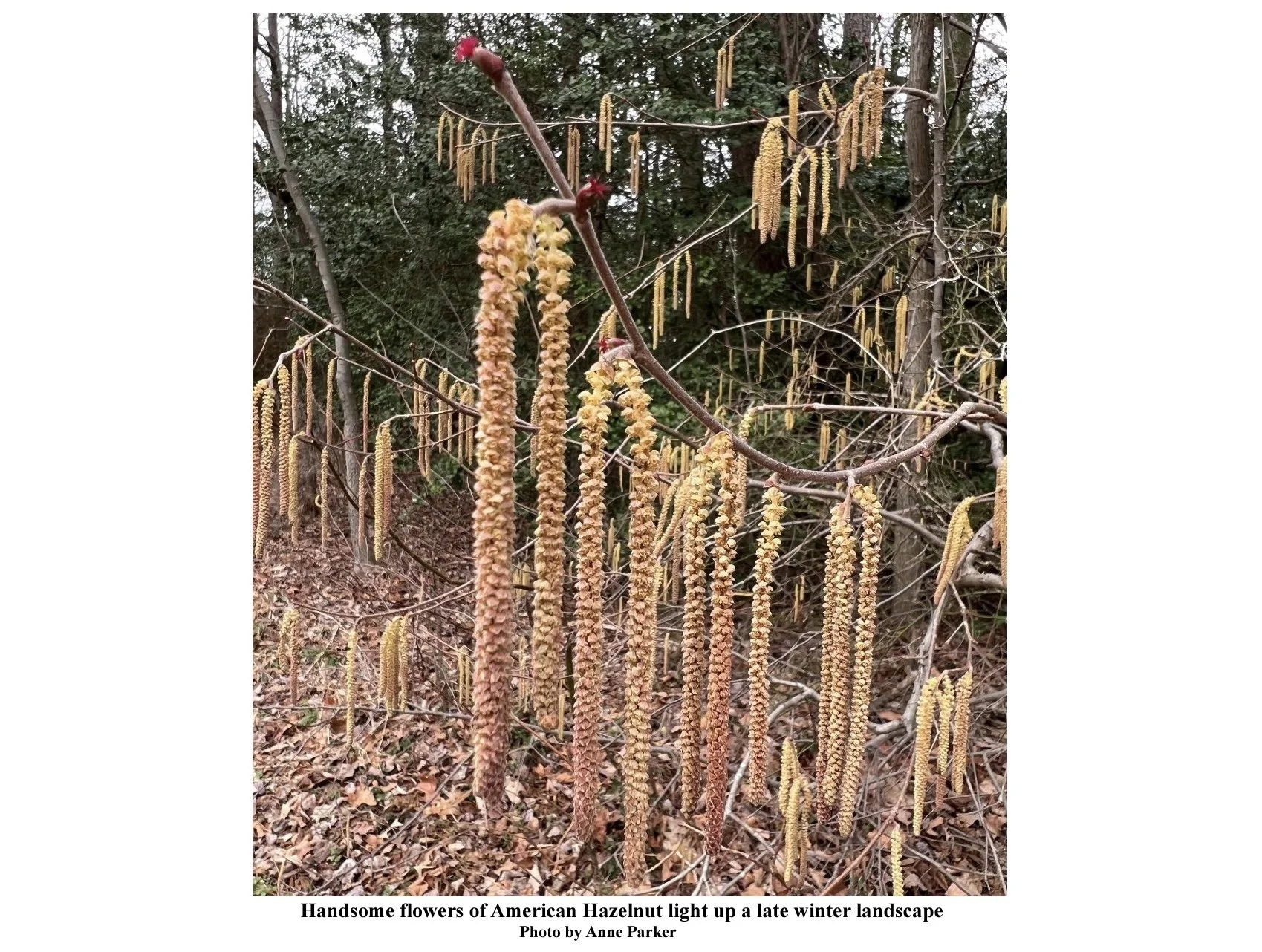
Our February Plant of the Month, American Hazelnut or Filbert, Corylus americana, is one of our earliest blooming native shrubs, a true harbinger of spring often flaunting its flowers as early as February. As a member of the Birch (Betulaceae) family, American Hazelnut is monoecious, meaning it has separate male and female flowers on the same plant. Like other members of the Betulaceae, the male flowers are held in narrowly cylindrical “catkins” (slim, cylindrical unisexual flower clusters) that dangle gracefully, two or three together near the twig tips. Elongating over the winter until they are 3 or 4” long, the pendulous catkins appear to drip from the slender branches creating a lovely late winter display. Each catkin contains numerous tiny flowers, each with a pair of tiny bracts and four stamens. Pollen is dispersed by wind to pollinate the tiny ruby red female (pistillate) flowers. Several are held together, extending beyond a swollen bud that is bsurrounded by red protective bracts. The flowers have no true petals, instead the small red stigmas create the ‘show’. Noted native plantsman, William Cullina, in his book, “Native Trees, Shrubs, and Vines” poetically describes the tiny female flowers as “sublime… fine ruby red stigmas poke from knobby red buds like little snake tongues to lick up pollen”. Ah, beauty and awe are so often in the details!
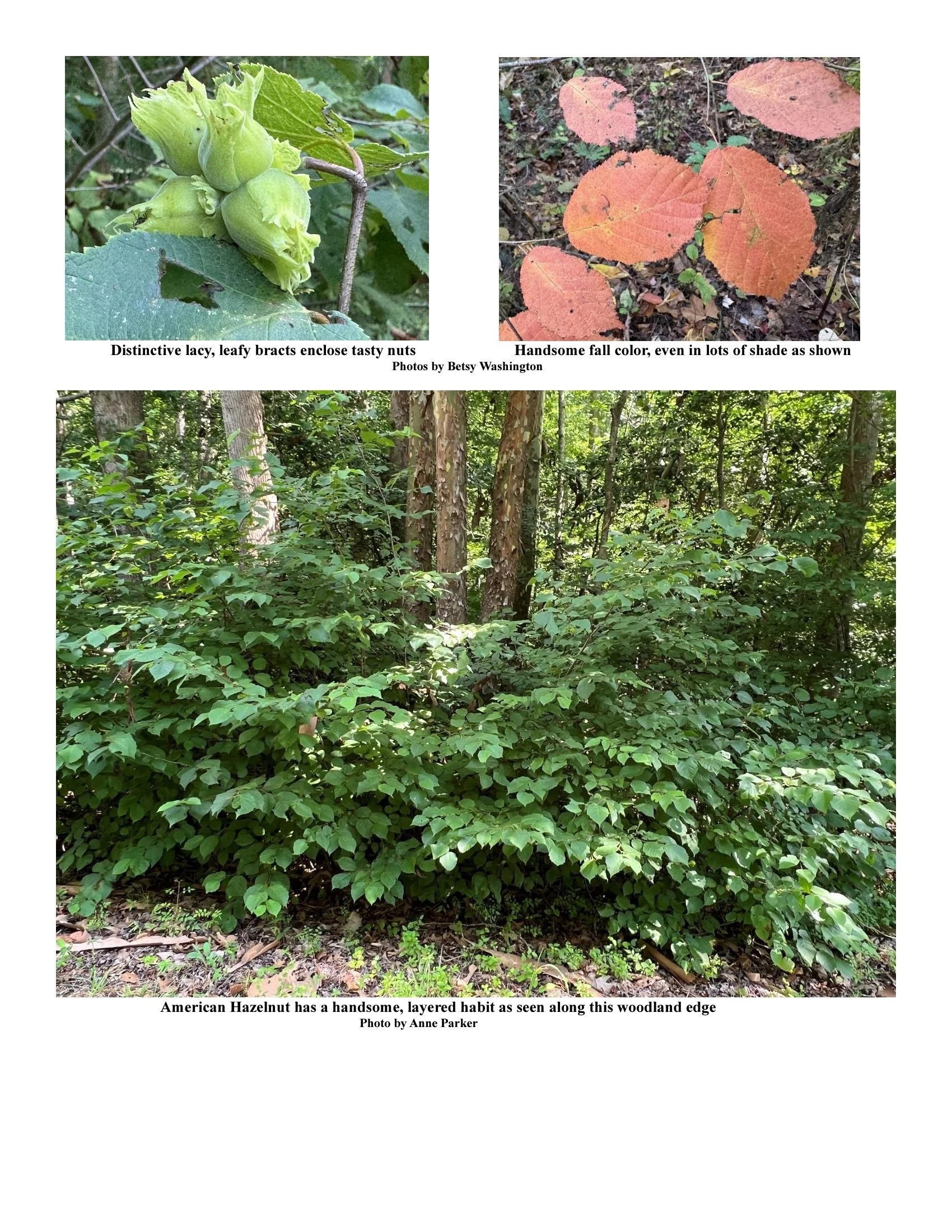
When pollinated, these intriguing flowers develop into edible brown nutlets enclosed in a pair of leafy bracts, often with two or three nuts held together in a tight cluster. The ends of the bracts extend beyond the nut and are distinctively ruffled or filigreed (in contrast to its closely related montane cousin the Beaked Hazelnut with a long slender beak-like structure at the end). The hazelnuts ripen in September and October and support an amazing variety of wildlife including Wild Turkeys, Bobwhite, Grouse, Blue Jays, Woodpeckers and small mammals such as squirrels, chipmunks, mice and raccoons. Further, our American Hazelnut, is reported to host over 120 species of moths and caterpillars (lepidoptera) including the large and showy Luna, Polyphemus and Io moths and, as you may know, moth and butterfly caterpillars themselves are the main food for over 90% of our songbird nestlings. The sweet, protein-rich nuts are highly nutritious and a favorite of humans, similar to their better-known cousins, European Filberts. In fact, American Hazelnuts or Filberts have been cultivated since the 1700’s and are delicious eaten raw or roasted or even ground into flour.
The deciduous American Hazelnut is quite handsome when given a few hours of sun, exhibiting an arching and layered, spreading habit and four seasons of interest. Capable of reaching 4 - 15’ high and nearly as wide, it grows naturally in a variety of habitats including both dry and moist upland mixed oak and oak- hickory forests, along woodland edges and openings as an understory shrub, in sandy thickets and well drained floodplains. In Virginia’s coastal plain I even find it along the edges of poorly drained, calcium-rich seepage swamps as in Cabin Swamp in Hickory Hollow Natural Area Preserve and along the Dragon Run in the Middle Peninsula. This rhizomatous shrub can sucker into colonies, creating excellent wildlife habitat and preventing erosion. The broadly oval leaves alternate along the stems with doubly serrate margins and can reach 3 – 6” long with distinctive pubescent stalks. Fall color is variable but often quite lovely, with warm shades of orange, rose, purple-red and yellow, even in heavy shade.
American Hazelnut is easily grown in average well-drained soil and is quite tolerant of soils from sandy to clay, moist to dry or even rocky as well as both acidic and basic soils. It tolerates full sun or shade and even grows beneath Black Walnuts – which you may know produce Juglone, a toxic chemical that inhibits plant growth around the Walnut. Deer do browse Hazelnut but by allowing it to sucker into thickets, you can allow deer to do the excess pruning for you. Beautiful when naturalized along woodland edges or gardens, American Hazelnut is also at home planted as a hedge, privacy screen, or even in an orchard or edible garden and is handsome enough to serve as a focal point. It can be pruned at any time of year, and excess suckers can be removed as needed or allowed to form a weed-smothering thicket. For nut production, it is best to plant in a relatively sunny site with several individuals together to ensure there will be cross pollination and plenty of nuts to go around - for both wildlife and humans. American Hazelnuts are moderately fast growing and begin producing nuts in their second or third year. Heavy nut production tends to occur every two or three years.
This versatile, four-season shrub features so many ornamental and ecological virtues and is so easy to grow, it is surprising that it is not planted in more gardens. Now, while the weather is cold, is the perfect time to scout out a spot for a few American Hazelnuts in your own garden to enhance its winter appeal and provide both beauty and food throughout the coming years.