Plant of the Month May 2026: Eastern Solomon’s-plume
The scientific name of the genus, Maianthemum, means May (Mai) and flower (anthemon). How appropriate for our May Plant of the Month as this lovely herbaceous perennial blooms across rich deciduous forests and woodlands of Canada and all the contiguous states from late April to June, peaking in May. Eastern Solomon’s-plume occurs in every county in Virginia and is common throughout in a diverse range of moist to dry upland forests and woodlands, well-drained floodplain forests, and clearings.
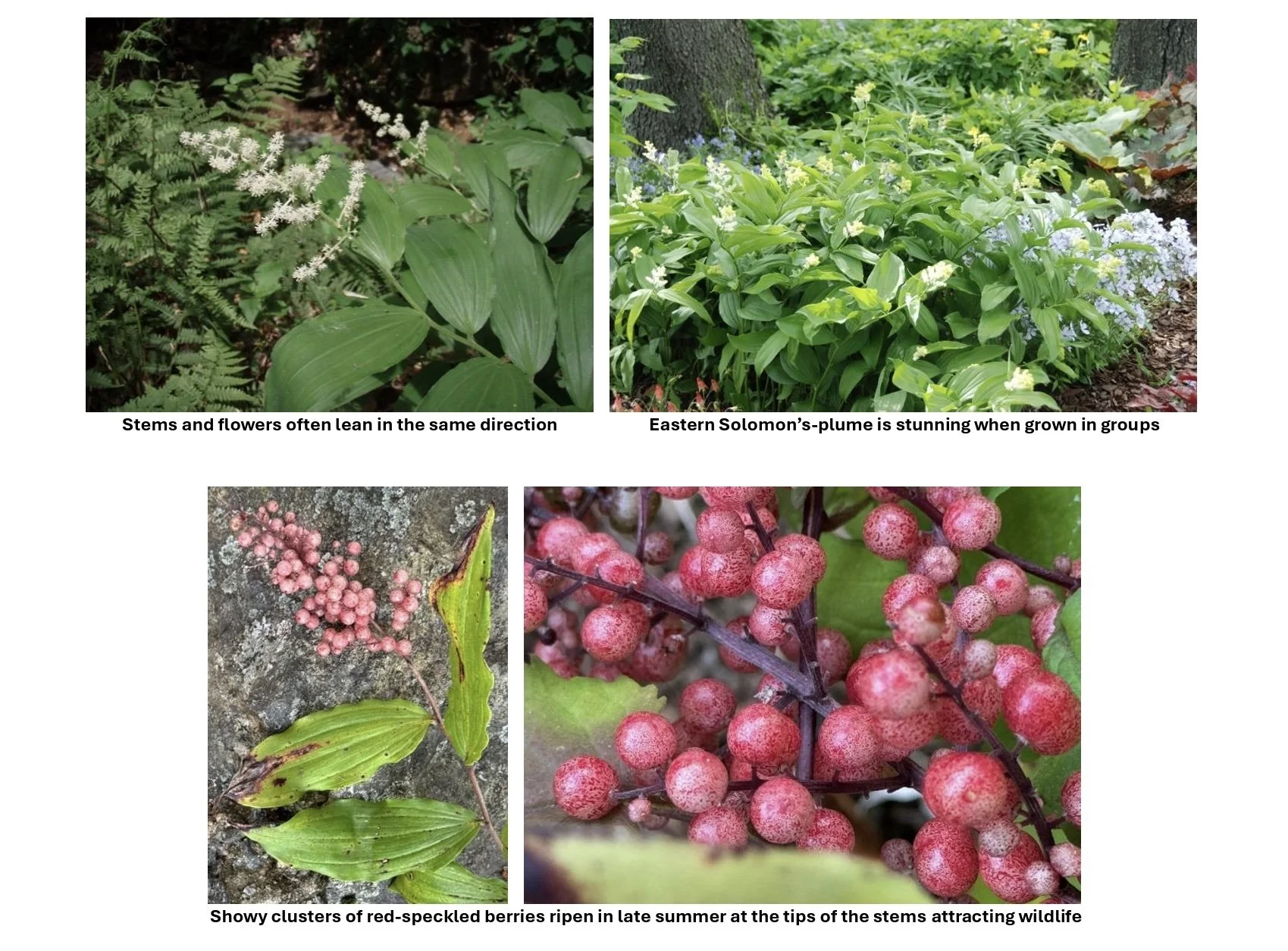
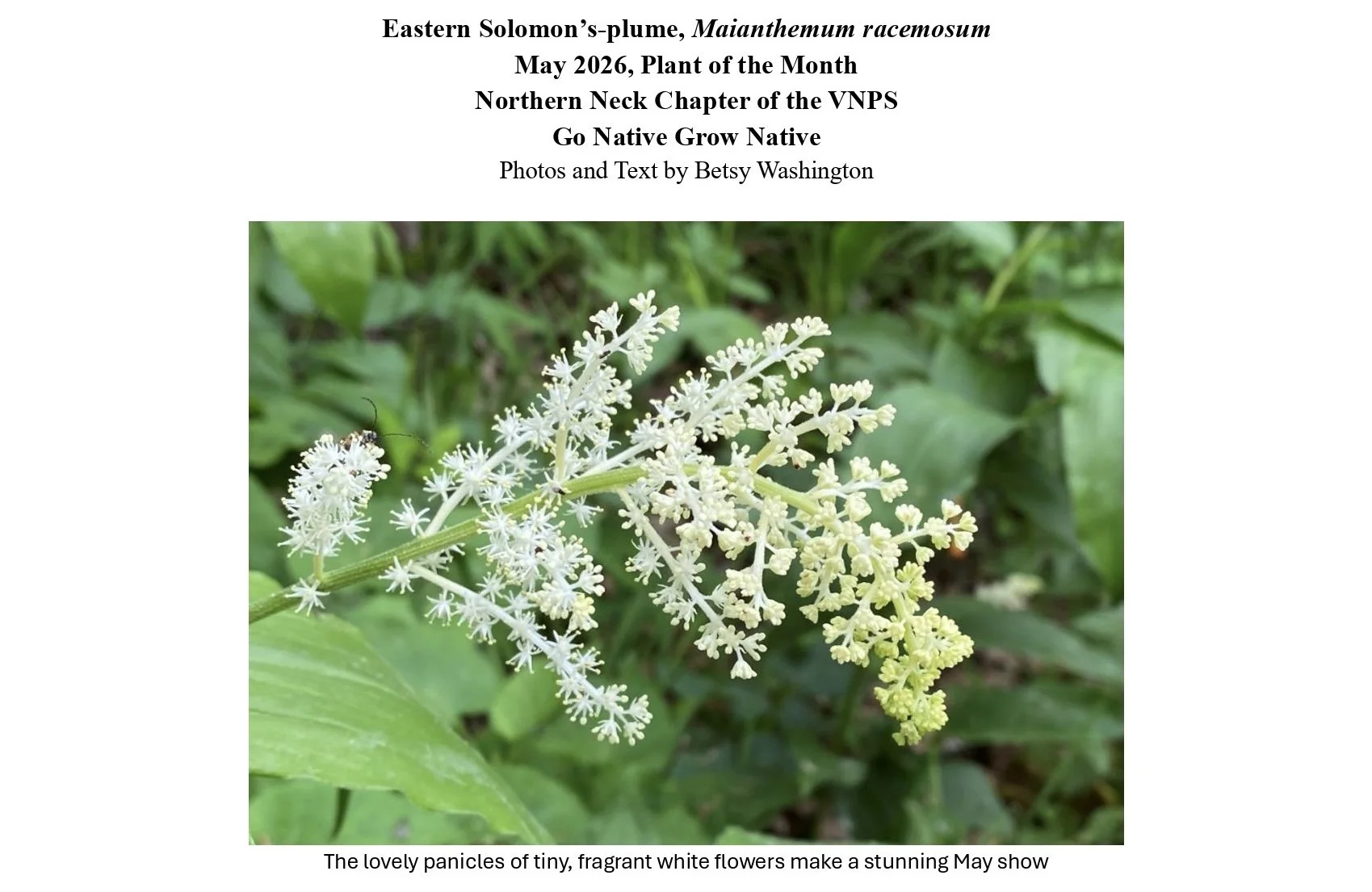
Each spring a single erect, unbranched stem arises from a thick fleshy rhizome. Light green pointed elliptic leaves with conspicuous parallel veins alternate gracefully along 2 – 3’ high stems that zigzag slightly, adding to the handsome architectural appeal. In fall the leaves often turn a handsome yellow gold. Over time, plants spread into colonies via rhizomes with many erect stems that tend to lean in the same direction towards sunlight giving an exceedingly graceful appearance. Even if this plant never bloomed it would be a standout! In May, showy panicles (branched racemes) of fragrant, small creamy-white flowers bloom at the ends of each stem for up to three weeks. Each 2- 5” long panicle consists of 20 – 80 quarter-inch diameter starry flowers, each with 6 tepals (indistinguishable petals and sepals) and six stamens tipped with creamy yellow anthers. These intricate panicles are incredibly beautiful, resembling feathery plumes hence the common name – ‘Solomon’s Plume’. It is especially lovely when it has spread into a colony with many graceful stems topped with panicles all pointing in the same direction. Once pollinated, the flowers develop into clusters of greenish berries that mature to red-speckled, white berries and then finally to a translucent ruby red in late summer and fall contrasting beautifully with the yellow fall foliage.
The terminal “plume” of flowers and subsequent cluster of berries at the tips of each stem, easily separate Eastern Solomon’s-plume from the very similar Solomon’s Seal which often grows in similar habitats and to which its common names (Solomon’s-plume and False Solomon’s-seal) refer. Solomon’s-seal differs in having the flowers and berries in groups of 2 -5 dangle below each leaf axil on slender stalks along arching the stems. The greenish-white, narrowly cylindrical, bell-shaped flowers mature to large dark blue berries that also hang below the stems.
Eastern Solomon’s-plume is easy to grow in moist but well drained soils in part shade to shade although it prefers rich, moist, humusy soil. Plants can be grown from seed or divided in spring or fall, but the roots of mature plants resent disturbance and may take a couple of years to bloom again. Plants may also struggle a bit in the hot and humid summers of the south. Solomon’s Plume looks best planted in groups of six or more but over time these rhizomatous plants will spread into handsome colonies on their own where they show to advantage when combined with low mounding wildflowers like Wild Ginger, Woodland Phlox, or Alumroot. They also look splendid combined with the airy foliage of ferns, Wild Columbine, or spring ephemerals. Solomon’s-plume adds height, drama and architectural interest to any woodland garden or border, but is also lovely along shady paths, streambanks or massed and will enhance any pollinator or wildlife garden.
Eastern Solomon’s-plume supports a diversity of wildlife including pollinators like small bees, several species of beetles, flies and moths. Songbirds and small mammals eat the berries. Humans can get in on the act too as the fruit can be eaten raw or cooked in jams or as molasses although they can have a laxative effect if too many are eaten. Native Americans ate the new shoots and fruit and made a medicinal tea from the leaves and roots.
We hope to have these gorgeous woodland plants available at our fall plant sale along with many shade-loving groundcovers that will complement their stunning architecture and multi-season appeal and create a dazzling woodland garden scene.